Kaiaulu Sentiment Analysis - NLP Pipeline Integration
Overview
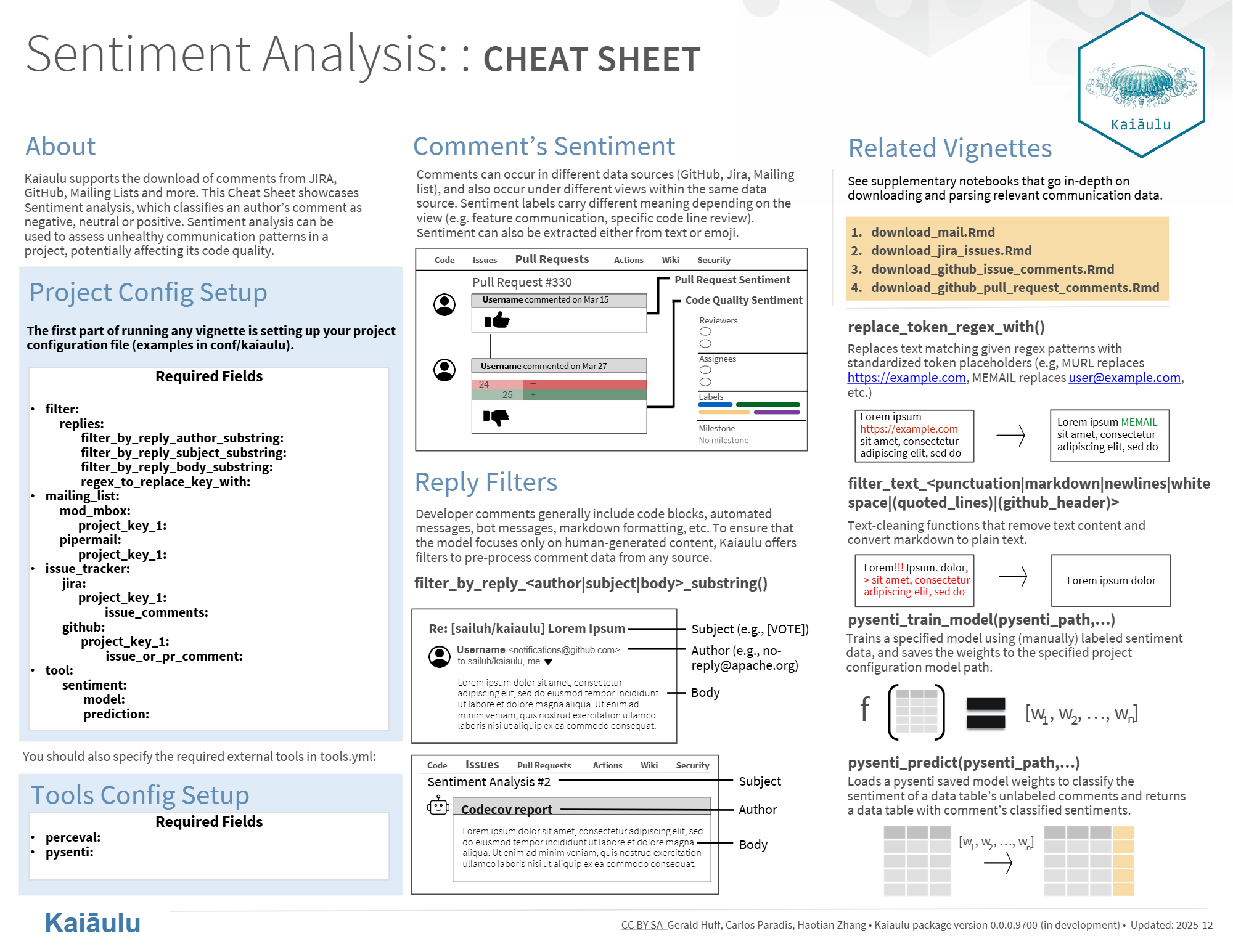
Independently extended and integrated a sentiment analysis pipeline into Kaiaulu, an open-source software analytics platform, building upon prior work to enable analysis of developer communication across GitHub, Jira, and mailing lists. The feature supports identification of communication patterns that may impact project health and collaboration.
Tech Stack
- Language: Python
- Libraries: Hugging Face Transformers (pre-trained models)
- Domain: Natural Language Processing (NLP)
- Platform: Kaiaulu (open-source software analytics system)
My Contributions
- Integrated an existing sentiment analysis system into Kaiaulu’s architecture, ensuring compatibility with its reproducibility-focused design
- Refactored the NLP pipeline to support a wider range of Hugging Face transformer models beyond the original implementation
- Implemented a text preprocessing pipeline using regex-based tokenization to normalize noisy data (emails, URLs, metadata) for accurate sentiment classification
- Enabled sentiment analysis across developer communication sources (GitHub issues, pull requests, Jira, and mailing lists)
- Preserved original model intent while restructuring code to align with platform constraints and extensibility requirements
- Conducted testing, debugging, and iterative development within an open-source workflow
- Led design discussions with project sponsor, using architectural diagrams to communicate implementation strategy and continuously refine code integration
Challenges & Decisions
- Adapted a research-oriented sentiment analysis implementation into a production-compatible system within Kaiaulu
- Balanced maintaining model accuracy with strict architectural constraints focused on reproducibility
- Designed preprocessing strategies to reduce noise in real-world developer communication data without losing semantic meaning
- Required deep understanding of an existing codebase to safely integrate and extend functionality
Links
Check out the official Kaiaulu website